After the Election: scenarios and probabilities
In a twitter follow-up on my previous post on the flow-diagram of Italian Elections, I've been suggested to attach to my various scenarios on the election results some probabilities. This goes nowhere near professional estimate such those put forward by Alessio in the 2016 Constitutional referendum; they are rather a "fun" exercise to attach some data to an otherwise theoretical diagram. In respect to the original diagram, I also came up with an additional scenario (which originally I considered embedded in the first one): the "Responsibility coalition", or right-wing + external friends.
Let's start by recalling the nodal model. We will explore, in particular, the right-end of the diagram, given the strong likelihood that the right-wing coalition will win the elections. What do we mean by "winning"? in the current Italian electoral system there is no Majority Premium; the seats in the lower chamber are attributed by 37% with a First Past the Post method; the remaining 63% are attributed through a list-based proportional system with a threshold of 3%. Hence, the share of votes of a party does not necessarily translates into seats in the parliament: if the party runs on its own, it may have high share of votes but losing each single FPTP constitutency, as it happened to Farage's UKIP in 2015 (12% of the vote, but only 1 MP elected). If the party runs in a coalition, it may not have a FPTP constituency at all, or share those with the coalition partners. This, of course, complicates the matter when attempting to estimate who "wins" the election. For the sake of simplicity, we will consider "the winner" the party or coalition with the largest share of votes, although this admittedly is very simplistic.
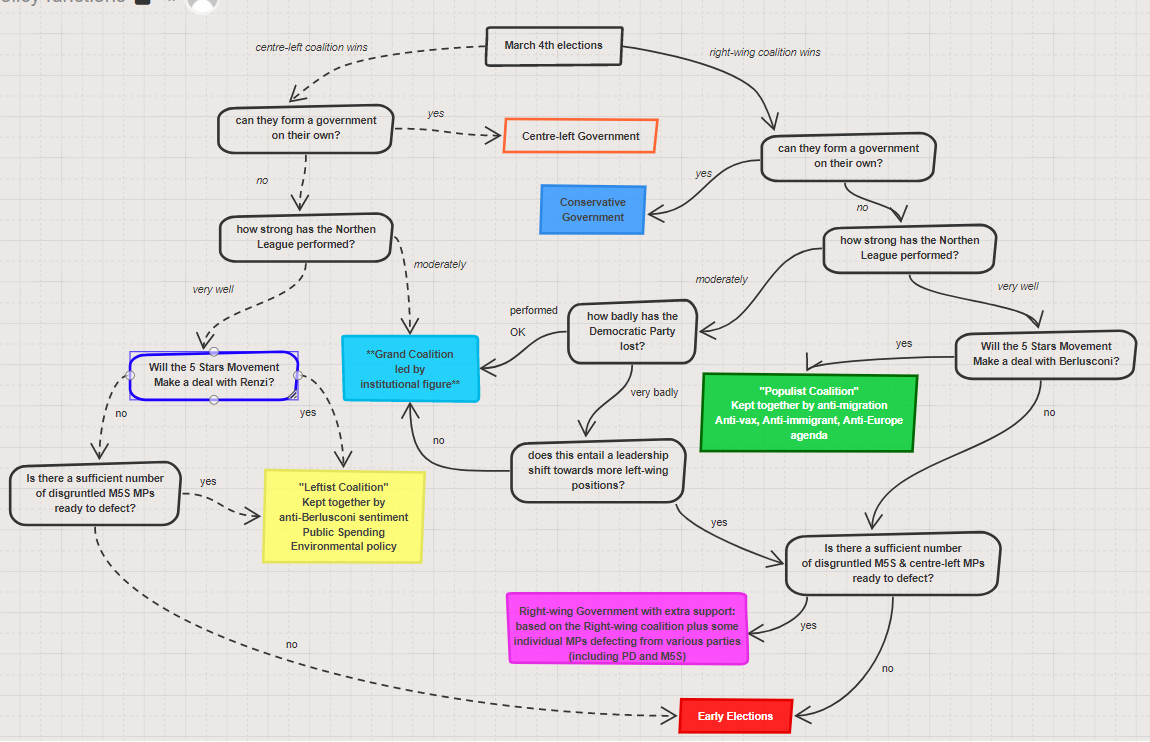
Node One. The right-hand side of the diagram is by far the most interesting, for it's also the most likely to happen. According to the poll-tracker Termometro Politico, the Centre-Left coalition is situated in between a minimum of 25,7% and a maximum of 29,8% (most negative and most positive polls); the Five Stars Movement in between 26% and 28,3% (but since the party runs on its own, this would make the M5S the first party by a long shot). Finally, the right-wing coalition is estimated in between 35% and 39,2% of the votes. This means that- even considering the most positive poll for the centre left and the most negative poll for the right-wing coalition, a gap of over 6 points remains between the two coalitions. Considering that the polls have been rather stable during all the campaign and only 3 weeks are left, it is safe to assume that the odds that the right-wing coalition will outmatch the centre-left are above 95%.
Node Two. Will the centre-right, despite the win, being able to form a government of its own? Given the FPTP system, it is very hard to estimate it at the moment. According to an estimate from IPSOS, the right-wing coalition is deemed to collect at least 269 seats; far away from the absolute majority of 316 MPs. As the authors recognise, however, the double electoral system would ensure that -if a coalition obtains at least 40-42% of the voting share- the chances that this coalition does not achieve an absolute majority are low. since the highest estimate put the right-wing coalition at 39% of the votes, it is reasonable to expect that- in absence of deep changes in the next 3 weeks - they won't be able to reach a 42% share, although they may be very close to it. The very latest projections, conducted by the University of Bologna, by a professor associated with the Democratic Party put the right-wing coalition only a few MPs from the absolute majority. To give a number, we could say that there is about 50% chance the right-wing coalition won't be able to form a government on its own but will need to seek for external support; however, this required external support may be very small in numbers.
Following this analysis, we have 5% chance Berlusconi will lose the election; about 47% probability that Berlusconi will be able to forge a government on his own, and about 47% he will need to seek external support. Which kind of external support depends, however, primarily on the performance of the Northern League (and the small but growing far-right party Fratelli d'Italia-FdI).Node Three. How will the Northern League and FdI perform? If Berlusconi has to reach out to the Democratic Party to form a Government the Northern League & FdI won't participate. Hence, the PD needs to take enough seats to fill the gap and compensate for the Northern League in order for the PD to become junior coalition partner. According to the latest projection, the NL+FdI will obtain at least 134 seats, more than the half of the right-wing coalition total. Forza Italia (Berlusconi own party) and his satellites parties will surely obtain at least 131. In the worst-case scenario for the right-wing coalition (where they lose to the PD all uncertain seats) the centre-left coalition would have just enough seats to compensate for the Northern League and Fratelli d'Italia. This, alone, would put the chances of such event quite low- at about 20%. However, it may be likely that in other scenarios some moderate members of the Northern League may defect to support a grand-coalition government. Hence, we assign a 30% chance to event that the Northern League won't have a veto power on the right-wing coalition post-electoral alliances, and 70% that they will.
Node 4A- How badly did the PD lose? This is, arguably, one of the most difficult questions to answer. The PD is likely to lose rather badly, but it can still maintain the keys of government if the Northern League performed bad enough. Since the centre-left needs to compensate for the Northern League and FdI to form a grand coalition government, I postulate that the PD loses "badly" if its coalition obtains less than 30% more seats than the Northern League and FdI. According to the latest projections, the total centre-left coalition is actually behind the Northern League and FdI. the Democratic Party alone will have approximately the same number of MPs of the Northern League. The chances that it will have enough MPs to sobstitute for the Northern Leauge are hence pretty small according to the latest polls: something like 30%. Much more likely is that this will be a total meltdown for the Centre-Left coalition. In that case, a leadership challenge to Renzi is pretty much unavoidable- we can assign it a 95% probability. This may lead to an exodus of centrist MPs and to the break-up of the coalition cohesiveness.
the Main implications of this branch of the model is that, in fact, the probability of a traditional Grand Coalition seem pretty low: below 5%.Node 4B- Will the Five Stars Movement join Berlusconi in a Populist coalition? The chance of this happening straight ahead are, I believe, very small. Although they have been politically sharing the bed for a while, it was a marriage of necessity to maintain the line of fire against Renzi, whose PD, just 4 years ago, steamrolled over them obtaining more than 40% of the consensus at the European elections. Deep down, I believe M5S and Berlusconi remain "arch-enemies", hence I do not see much space for a all-in alliance; say 5%. This would put the overall likelihood of such event at about 1,6%. However, it is much more likely that Berlusconi will be able to gather some of the disgruntled M5S MPs to form some kind of "responsibility coalition", which nothing else is but a group of unattached MPs that will support the right-wing government in exchange of some payouts. This group may be even reinforced by centrist elements of the centre-left coalition if the change in leadership in the PD moves the party substantially on the left, which is a 9,5% probability event. We had assumed that there is a 95% chance that the M5S won't directly ally with Berlusconi; however, I think that there is a high chance that Berlusconi will be able to gather a group of willing MPs defecting from the PD and the M5S to support him. In sum, the chances of a "grand Populist coalition" are pretty low: something like 1,6% if we take the model rigorously (which you definitively should not). Much more likely is a "Coalition of Responsibles" composed by disgruntled M5S and PD MPs in support of the right-wing coalition. The chances we end up there are pretty high: about 25%. This leaves out about 13% chance of early election.
To summarize:
- the most likely result is a strict right-wing government: about 48% of the probability.
- next in line is a right-wing government with the extra support of a "group of responsibles" composed by runaway M5S MPs and centrist fugitives who escape the left-wing, post-Renzi turn of the PD. This stands at about 32%.
- Third stands the possibility of early elections: about 8%.
- Fourth is the possibility of a traditional grand coaliton: about 5%.
- Fifth is a straight populist coalition, about 2% of the overall probability.