Evolving space markets: towards a real US leadership?
Since the victory in the Moon race, we are accustomed to think about the US as the leading power in space; the iconic Space-Shuttle, and the largely US-financed International Space Station (ISS) have substantially contributed to this perception. However, the US lost leadership in the market for orbital flights in the early 2000s: from 2004 onwards, the relative majority of the total orbital flights has belonged either to Russia or to China, as the dominance of high-cost vectors such as the Space Shuttle itself or the Atlas rocket pushed satellite operators towards much cheaper (although somewhat less reliable) Russian and Chinese launchers.
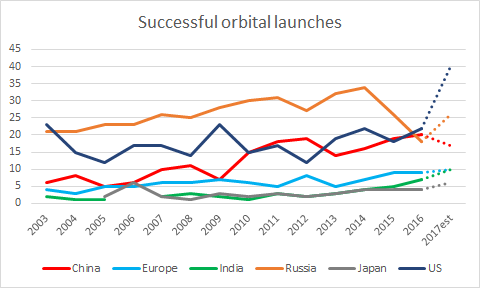
However, this is poised to change soon. SpaceX, the reusable rocket company of Elon Musk, has successfully managed to decrease costs substantially, generating a rush towards price competitiveness in the US; furthermore, several new rocket companies- including the Amazon-backed Blue Origins- are likely to get on the market in the next years. Already in 2016 the US got back the leadership in terms of number of flights; in 2017, the US are likely to strike their best year in the last 3 decades in terms of in space launches, with estimates ranging from 25 to 40 orbital flights. by 2020, the gap is deemed to widen further thanks to further cost decreases and expanded launch capacity, both for SpaceX (with a new heavy launcher coming online, and 2 more spaceports) and for newcomers such as Blue Origins. Furthermore plummeting costs have generated a wave of investment in new applications, from imaging to 3d printing to more futuristic ideas such as real estate; in turn, increasing demand will generate further investment in reusable launch technologies. Dramatic failures notwithstanding, it looks like the US will achieve a real space leadership once more, driven- this time- by brave private entrepreneurs rather than the protective (but pricey) hands of NASA and the US Defense department. Interesting times ahead!