Will she stay or will she go?
Will she stay or will she go?
The UK is waiting to know the fate of May and of Brexit. A pivotal issue, at this point, is whether the Tories will force the election of a new leader, or whether May will leave as an exchange for the Brexiteers to back her deal.
Let's make a simple game-theoretical tree and reason by backward induction. To do so, we need to make some assumptions and attribute some payoffs.
Assumptions: (1) if a Tory leadership contest is run, there is a 75% chance that hard-brexiteer wins it, and 25% chance that a soft-brexiteer wins it.
(2) if a no-deal is about to happen, there is 90% chance that a last-minute cross-party coalition will form to stop it, and 10% chance that this won't happen (and therefore no-deal would get through)
payoffs: We assume that May's top objectives are, in this order, to remain in power and to get her deal through. In other words, for May, herself > her deal > her party > her country. Accordingly, May gets 10 points for staying in power & 5 points if her deal passes. She loses 10 points if forced to step down; she loses 10 points if her deal is completely rejected; she loses 5 points if her deal is changed (either to make it stronger, or softer).
the ERC top priority is to get a proper, proud, English no-deal. Immediately after, they aim to get rid of May. Accordingly, the ERC gets 20 points for a no-deal brexit. They also get 10 points if she steps down. They lose 10 points if May deal is passed; they lose 2,5 points if a harder version of May deal is passed; they lose 2,5 points if May stays; they lose 20 points if brexit is delayed.
The resulting tree can be seen in figure 1 below; the payoffs on the left refer to the ERC, the payoffs on the right to May. As it is apparent, the worst possible outcome for the ERC is Brexit delayed & May remains. The worst possible outcome for May is her resignation and a rejection of her deal (either with a customs union, or with a delay).
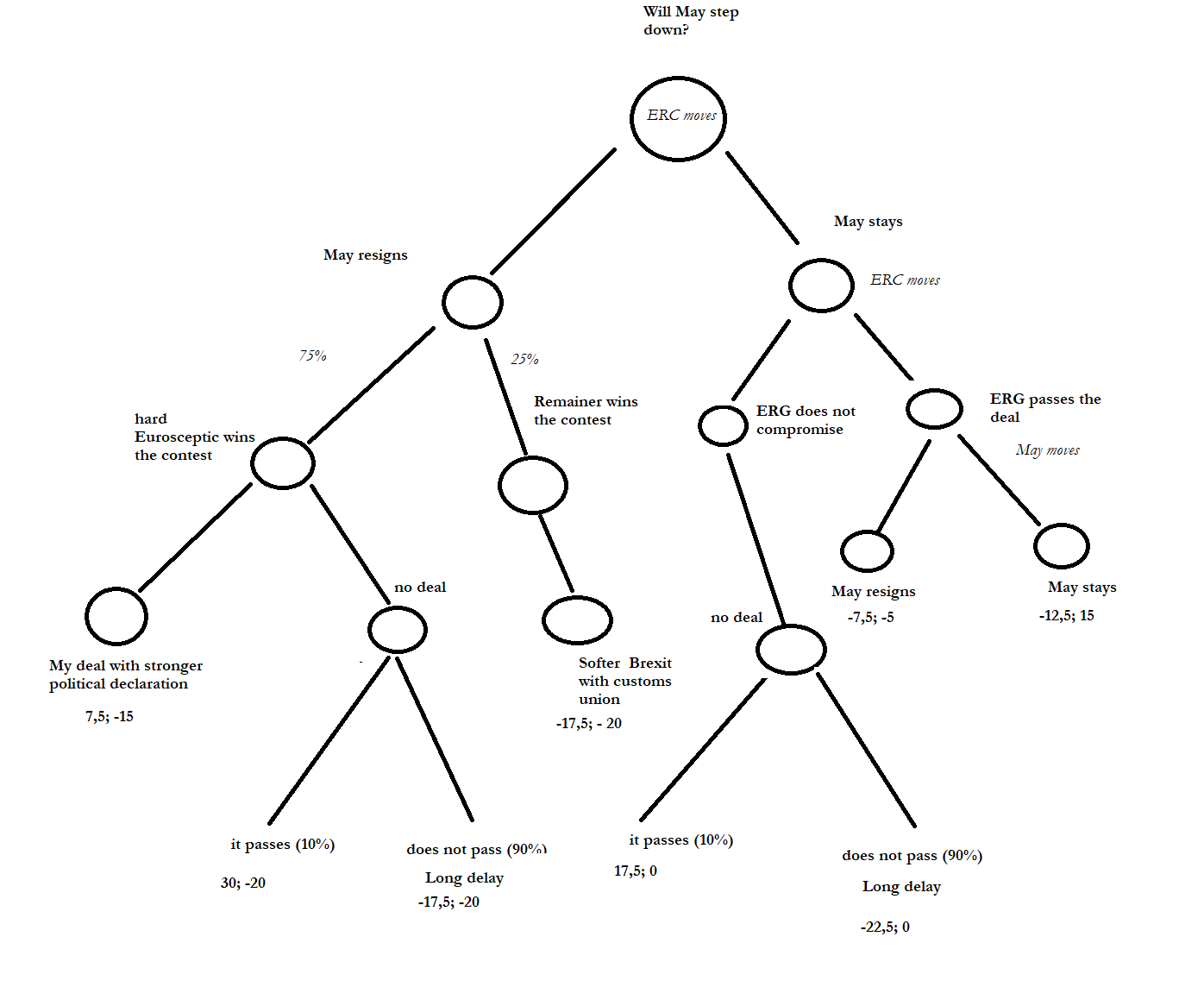
By resigning before the Brexit process is completed, May would substantially increase the chances that she ends up in the worst possible outcome for her. So expect her to fight like a lion to remain in charge of the Government until brexit is sealed.
Unfortunately for her, the ERC can have different incentives. If she remains in power, the ERC does not compromise, the ERC has a 10% chance of getting a no-deal through, and a 90% chance of ending up in their worst possible outcome. But if they compromise, why should May resign, when she would be so close to her best possible outcome?
It follows that the ERC has a strong incentive to anticipate the moment of resignation. If May is forced to step down now, they are likely to win the replacement contest. At that point, they can steer the process towards a risky attempt- try to get a no deal through the Parliament with delay tactics- or to get a stronger political declaration through.
All in all, most results on the left side of the tree are better, for the ERC, than most results on the right side. And the other way around. So pressure on May will keep rising, and her resistance will keep increasing too. If the order of May's priorities is different than what assumed here (we assumed herself > her deal > her party > her country), and in particular if the order is (her deal > her party > herself > her country) the results would change- but not that much. in the latter case, the equilibrium would probably be found in an agreement with the ERC followed by her stepping down. But what if her priorities were of the kind (her country > her deal > her party > herself)? Well, in that case we wouldn't even be here, wouldn't we.